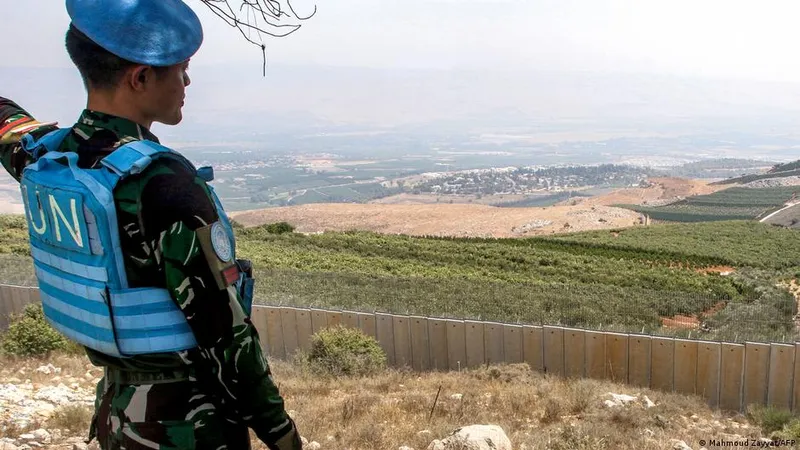
Lebanon faces uncertainty as UNIFIL mandate nears end
The United Nations Interim Force in Lebanon (UNIFIL) is set to begin withdrawing from the Blue Line zone on December 31, 2026, leaving southern Lebanon in uncertainty as no agreement has been reached on a replacement international force.
Lebanese Prime Minister Nawaf Salam has warned of the need to 'avert the vacuum that UNIFIL's withdrawal could create, were it to take place without agreement on a new international force to replace it.' The Lebanese government has been pushing for a last-minute extension of UNIFIL's mandate but has so far been unsuccessful.
The Blue Line, which stretches for 120 kilometers (75 miles), is a UN-identified line of withdrawal between Israel and Lebanon, not an internationally agreed border. Established in 2000, it has been patrolled by UNIFIL troops since 1978 when multinational forces were deployed after Israel invaded Lebanon in response to attacks by Palestinian armed groups.
Following the 2006 Israel-Hezbollah war, UNIFIL's mandate was expanded to support the Lebanese army in implementing UN Security Council Resolution 1701, which calls for an area between the Blue Line and the Litani River to be free of armed personnel, assets and weapons other than those belonging to the Lebanese government and UNIFIL.
Current conflict complicates withdrawal
However, following cross-border attacks by Hezbollah in October 2023 and the ensuing war in 2024, Israel has been occupying large swaths of Lebanese territory in a self-declared security zone called the Yellow Line, located north of the Blue Line. Of the more than 1.2 million people displaced in Lebanon during the renewed conflict in 2026, around 329,000 remained internally displaced as of September 29.
Israel has caused extensive destruction to homes and key infrastructure in southern Lebanon, citing the need to protect its citizens in northern Israel from attacks launched from the area. Hezbollah, designated as a terrorist organization by several countries including the US and Germany, continues to reject disarmament, citing the need to defend itself as long as Israeli forces remain in Lebanon.
Lebanon's government faces dilemmas
The upcoming withdrawal highlights two major dilemmas for Lebanon's government. Beirut is concerned that violations of agreements on either the Israeli or Hezbollah side can't be tracked without an international military force. Furthermore, Lebanon's economic lifeline depends on international funding, much of which is tied to Hezbollah's disarmament.
After years of political deadlock, the COVID-19 pandemic, soaring inflation, economic crises, and the Beirut port blast in 2020, Lebanon's government has limited options for disarming Hezbollah. President Joseph Aoun and Prime Minister Nawaf Salam have opened direct talks with Israel, but this process excludes Hezbollah and its backer Iran, both of which oppose the group's disarmament.
Beirut has few bargaining chips in negotiations with Israel because it has been unable to secure Hezbollah's compliance. Trying to force Hezbollah to surrender its weapons could trigger a deadly domestic conflict, as the group has openly warned in the past.
EU mission offers partial solution
On October 12, European Union foreign ministers agreed to establish a European Union Support Mission in Lebanon (EUSM Lebanon) with an initial three-year mandate. The mission has both civilian and military components and is intended to strengthen the capabilities of the Lebanese armed forces and internal security forces, particularly in border security.
However, the mission is not intended to replace UNIFIL. Rather than deploying peacekeepers to patrol southern Lebanon, it will initially operate north of the Litani River. Several existing UNIFIL contributors, including Italy, France, Spain, Ireland, Germany, Austria, Finland and Poland, have expressed interest in contributing personnel and resources to the new mission.
For the government in Beirut, this is a positive signal. Lebanese society strongly supports the Lebanese military, which many see as the only institution in the country that can uphold Lebanon's sovereignty and represent the entire nation. The withdrawal of UNIFIL forces will begin in stages after December 31, 2026.
Related
